Reggio Emilia · Motor Valley
The Reggio Emilia workshop
How a piece is made, the materials, the provenance, and who makes it.
At Arteinmotion’s workshop in Reggio Emilia, Italy, aircraft parts, most of them at the end of their service life, are dismantled, selected and polished, and upcycled into furniture such as tables, bars and reception desks, mirrors and lamps that keep the form and the marks of their original function. Every piece leaves the workshop with its provenance stated.

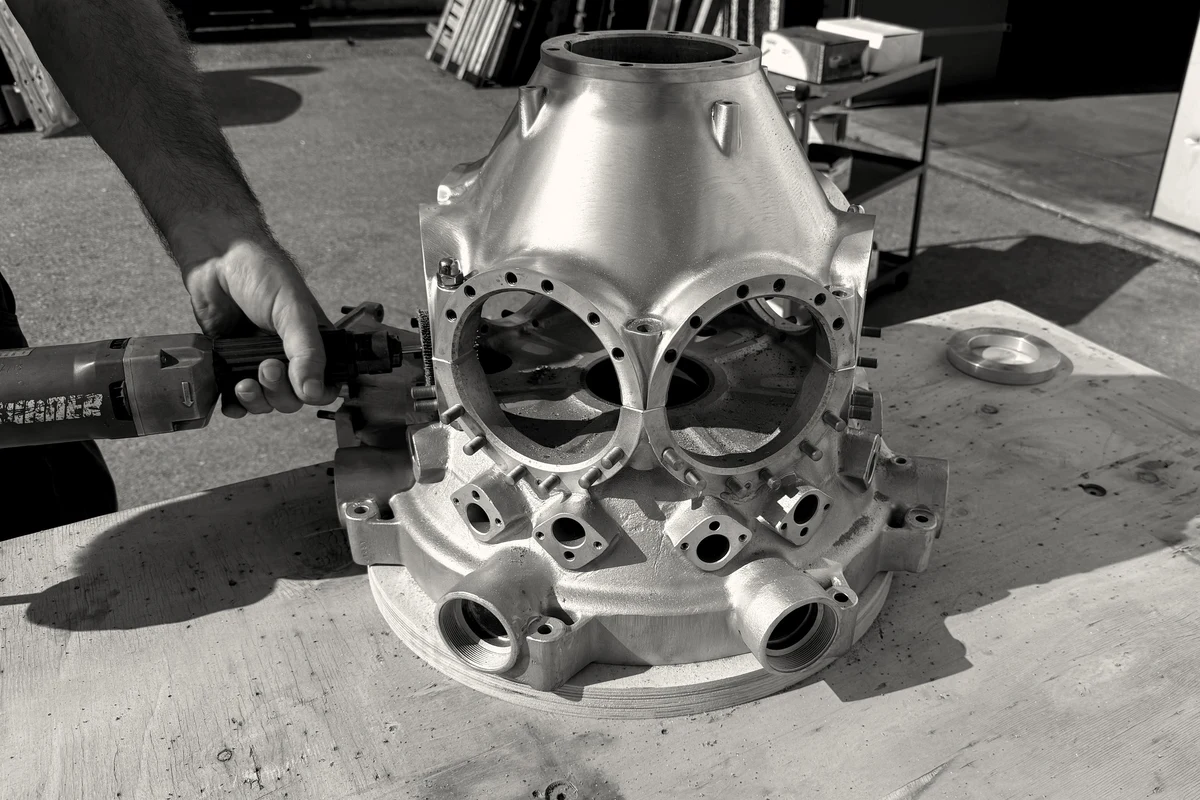
Jacobs radial engine section · Salone del Mobile 2022
The workshop lies at the heart of Emilia's Motor Valley, where aluminium working and mirror finishing are skills rooted for generations in the region's companies and suppliers.
The original parts
The recovered components are parts retired at the end of their service, never from accidents. They reach the workshop in the state in which they stopped flying: a nacelle panel still carries traces of oil, the acoustic insulation glued inside and the hinge fittings, and one of our fuselage panels still wore its USAir livery. This is where the work begins.


How a piece is made
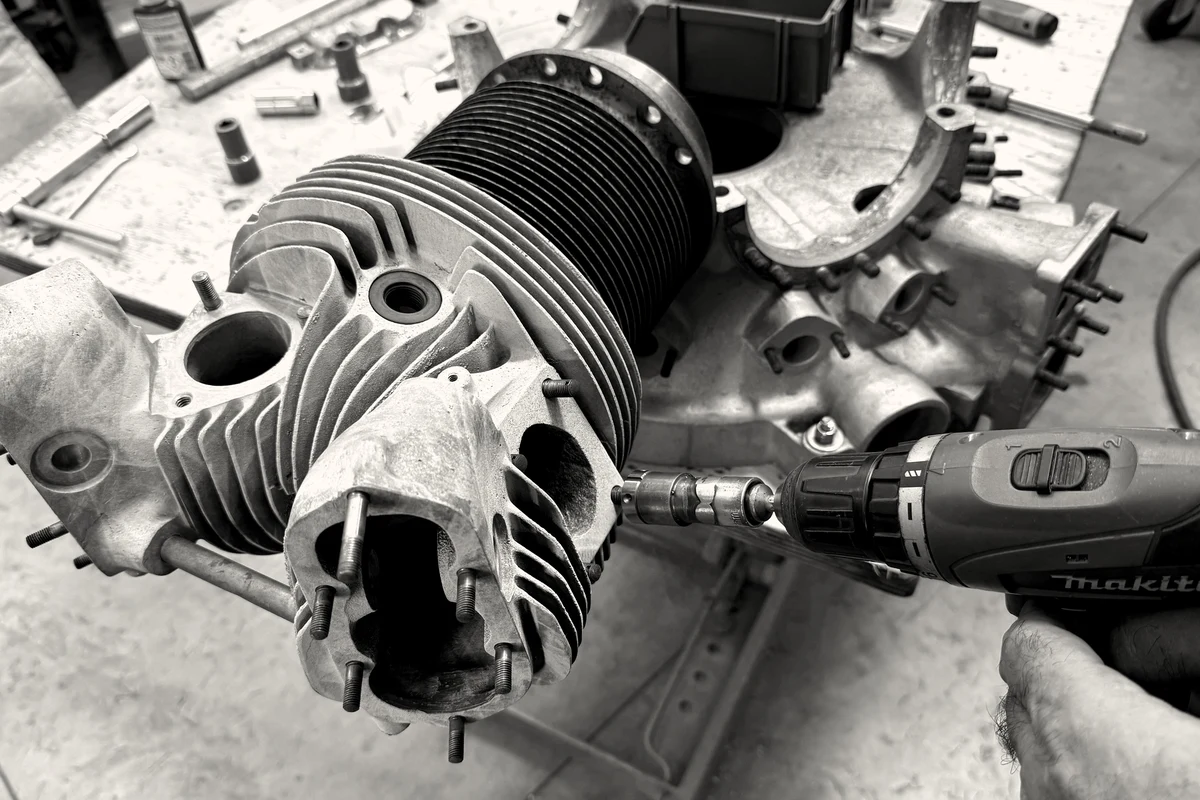
The process begins with dismantling, which frees the sheet metal from insulation, seals and wiring. In radial engines all the fasteners, which are imperial, are also replaced. It is at this stage that data plates and part numbers come to light, the first elements on which the provenance of the piece is built.
Selection follows. Corrosion, distortion and repairs made in service determine what to keep and where to cut, and the final size of the piece depends on this choice more than on any drawing. On a DC-8 engine cowling, with its compound shape and few reference points, marking out the cut alone can take two days of work. The material left over is sent for recycling.

Polishing is the longest and most delicate stage. The aircraft sheet of these generations is almost always Alclad: a high-strength alloy, usually 2024, protected by a thin cladding of nearly pure aluminium. That cladding accounts for between one and fifteen per cent of the thickness, and polishing correctly means stopping before it is removed, because beyond that limit the surface stays bright but loses its protection. On a DC-8 cowling a mirror finish takes nine or ten passes, and a mistake in a single one means starting again from the beginning. The titanium rivets, a few millimetres from the aluminium, are polished separately, with dedicated techniques. For a bar made from one of these cowlings, the polishing alone takes at least a hundred hours.
Assembly completes the piece with glass, supports, lighting and mechanisms, according to a constant principle: the aircraft part must remain readable as such, because it is the very reason for the object.


Not everything gets polished
Metal reaches a mirror finish by subtraction, removing paint and oxide. For some materials the process is the opposite, and the work lies in preserving.
Vintage wooden propellers keep their paint, their stamped numbers and the strip that protects the leading edge, because these marks document their history. The wood of the Sensenich propellers is entrusted to a professional restorer, who finishes it with shellac in the manner of antique furniture. The Stearman's wing structure is also wood, built new to the original drawings and left without its fabric. Those drawings, dated and signed, were redrawn in three dimensions in our workshop so that the spars could be CNC-machined.
The 737 exhaust mixer is made of Inconel, a nickel superalloy designed for the engine's hot stream, which resists abrasion as well as it resists heat. Like titanium, it is polished on its own, because working it together with aluminium would damage both metals. In radial engines, finally, the crankcase is often magnesium alloy, a metal that cannot be left bare and is therefore washed, blasted and painted inside and out.
Provenance
We photograph data plates and stamps as soon as they come to light. The page of each recovered piece states what is documented about its part, according to three levels of provenance: the exact aircraft, the aircraft type, or only that the part is genuine. What is not documented we state as such, and no registration or date is ever assigned by assumption. Every recovered piece comes with its own certificate of provenance.


Who makes it
The workshop and the warehouse share the same premises in Reggio Emilia. Here the parts are worked and the finished pieces are kept, and from here we send architects and designers the technical documentation for each piece. Since 2011 Arteinmotion has presented its work at the Salone del Mobile in Milan and, on request, handles installation with its own staff, abroad as well.
The workshop can be visited by appointment. Alongside the finished pieces you can see those in progress and the parts still waiting to be dismantled, which are often the most interesting of all. To arrange a date, write to us through the contact form. You will hear back from the people who make the pieces.