
Radial engine coffee tables, tables and wall sections
Coffee tables, side and dining tables and wall pieces made from real Jacobs, Continental and Lycoming radial engines, built between 1929 and the 1970s. The radial engine is the one aircraft component that was already an object before we laid a hand on it: seven or nine cylinders arranged in a star, built to be looked at while they turned. Eight pieces in the collection begin here. Usually available from stock: the Jacobs R-755 and Continental W-670 coffee tables with the complete engine, and the two wall engine sections; the other pieces are made to order.
The pieces that come from it
8 in the catalogueA radial engine has its cylinders arranged in a star around the crankshaft, like the spokes of a wheel, and it is air-cooled. It dominated aviation until the 1950s for three reasons: reliability, simplicity and low weight. Then the turbine arrived, which for the same power is simpler, lighter and needs less maintenance, and the radial left the stage.
Why the cylinders are always an odd number
Seven, nine, eleven. Never eight, never ten. It is not a convention: it is a mechanical necessity. In a four-stroke each cylinder fires every two turns of the crank, and for the firing to be evenly spaced in time they must fire on alternate cylinders: one, skip one, going twice around the star. With an even number the sequence would close on itself after half a rotation and half the cylinders would be left out. The firing order of a seven-cylinder is therefore 1-3-5-7-2-4-6: all the odd ones first, then all the even ones. A seven-cylinder fires every 102.9 degrees of rotation, a nine-cylinder every 80.
There is a second oddity, and you see it when you strip one. Only one piston is connected to the crankshaft. The other six or eight are attached to a flange on that first connecting rod, the master rod, by knuckle pins. The consequence: their journals describe an ellipse instead of a circle, and the pistons do not all travel the same distance for the same rotation. It is an engine in which no cylinder does exactly what the others do.
The three makers, and why your tables are all the same size
Jacobs Aircraft Engine Company was founded in Philadelphia in 1926 and closed in 1957, with its works at Pottstown, Pennsylvania. Its R-755 (seven cylinders, 12.4 litres, 225 horsepower) has an external diameter of 110.5 cm and weighs 229 kg. Between the pre-war years, the war and after it, Jacobs built about 22,800 engines. It was known as Shakin' Jake, for the way it shook at low revolutions.
Continental entered aviation in August 1929. Its R-670, later W-670 — seven cylinders, 11 litres, 225 horsepower — is 108 cm across and weighs 204 kg. It is the engine of the Boeing Stearman PT-17, and not only that: the W670-9A variant also drove the M3 Stuart light tanks and many of the LVT amphibious vehicles. The same engine as the training biplane made the tanks walk.
Lycoming built its first aero engine in 1929, the R-680: nine cylinders, 11.15 litres, up to 330 horsepower, 110 cm in diameter, 225 kg. About 25,000 were built.
This is why the tables in this collection are all of similar size: the three engines fall between 108 and 116 centimetres. It is neither a coincidence nor a matter of taste. They are all seven- or nine-cylinder radials of the same power class, two to three hundred horsepower, built for the same trainers. The collection is coherent because the category was.
Why they can still be found today
The answer is one word: surplus. The United States built almost 300,000 military aircraft during the war and about 230,000 were left at the end of it. The Boeing-Stearman alone was produced in at least 10,626 examples; the Cessna Bobcat, which carried two Jacobs engines, passed 5,400 between the United States and Canada.
What happened next is documented, and it is the reason the pieces on this page exist: the agency charged with disposal expected to recover part of the cost by selling the engines and accessories and scrapping the aluminium airframes. More than five thousand aircraft ended up in the yards at Kingman, Arizona, and almost four thousand at Walnut Ridge, Arkansas. The engines were sold separately, and thousands of aircraft had a second life as crop dusters. Delta Air Lines bought them by the dozen, and by 1954 its agricultural division had thirty-one Stearmans.
What can be polished and what cannot
A radial is not made of a single material, and that changes everything in the workshop. The cylinder barrels are forged alloy steel, usually chrome-molybdenum, nitride-hardened: the cooling fins are machined from solid. The heads are aluminium alloy, chosen because it conducts heat well and weighs little. But the central crankcase is in many cases magnesium alloy, and the FAA's aviation maintenance handbook calls it, without softening it, «the most chemically active of the metals used in aircraft construction and the most difficult to protect»: it oxidises into whitish flakes if it is not treated.
What happens to an engine when it reaches the workshop
The crankcase has a magnesium base, the metal the FAA handbook calls the most chemically active of those used in aircraft construction, and indeed it cannot be left bare. The cycle is: washing, blasting, then painting inside and out. It is not an aesthetic choice: it is what holds the magnesium still.
It is not all magnesium. Some covers that were originally magnesium are replaced with the same covers in aluminium, period originals, bought as spares from stores of parts that still fly. So: magnesium crankcase, aluminium covers and manifolds.
What is thrown away. Everything that was inside: pistons, connecting rods, pushrods, rockers, gears. All the screws, which are in inches, are replaced.
How long it takes. Carlo gives an answer that is both a measurement and an explanation: without proper industrialisation, bringing one of these engines to this level of finish would mean at least three months of continuous work. It is the reason a polished radial engine is not something you improvise.
Which engines they are, precisely
The data plates taken off the engines worked on over these years give the models. There are four, all American radials:
- Continental W-670 — seven cylinders, compression ratio 6.1:1, left-hand propeller rotation, firing order 1-3-5-7-2-4-6. It is the Boeing Stearman engine.
- Jacobs R-915-7, which in civil designation is L-6 (the plate gives the version, L-6MB) — seven cylinders, 300 hp at 2,100 rpm, 330 for take-off, serial 9699. Jacobs Aircraft Engine Co., Pottstown, Pennsylvania.
- Jacobs R-755-9 — seven cylinders, compression 5.4:1, Air Corps contract
W535AC-32745, order numberJ-02-3023. - Lycoming R-680-13 — nine cylinders, firing order 1-3-5-7-9-2-4-6-8, contract
W-535-AC-23958. The Aviation Corporation, Lycoming Division, Williamsport, Pennsylvania.

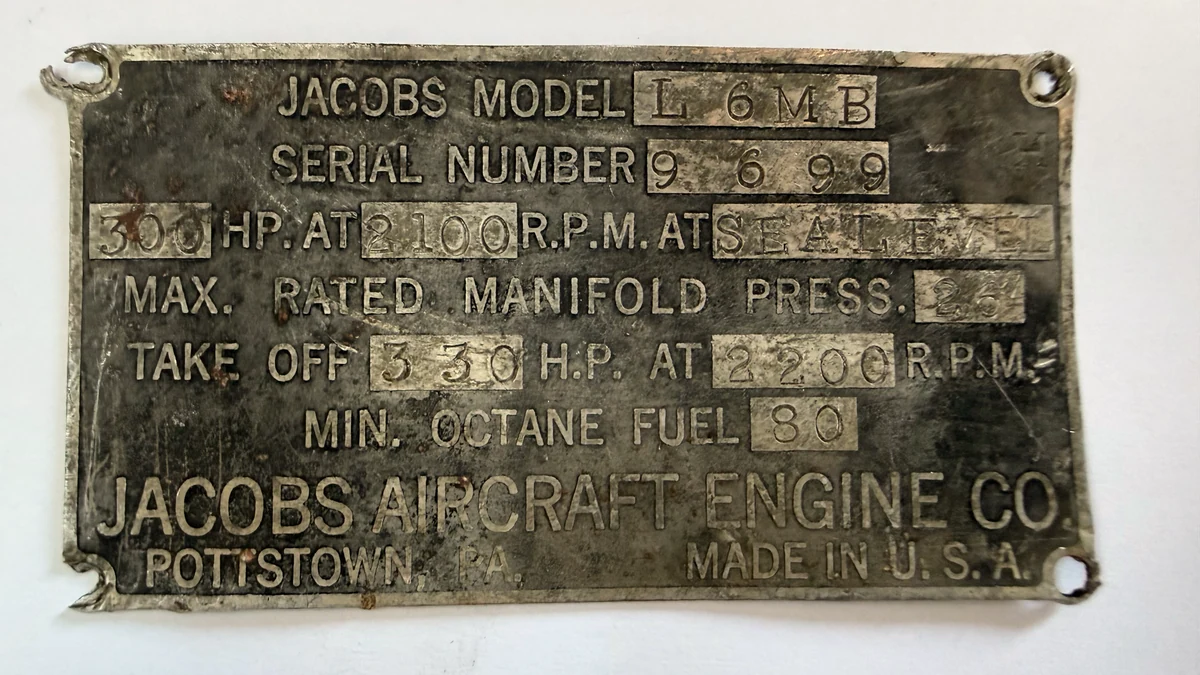

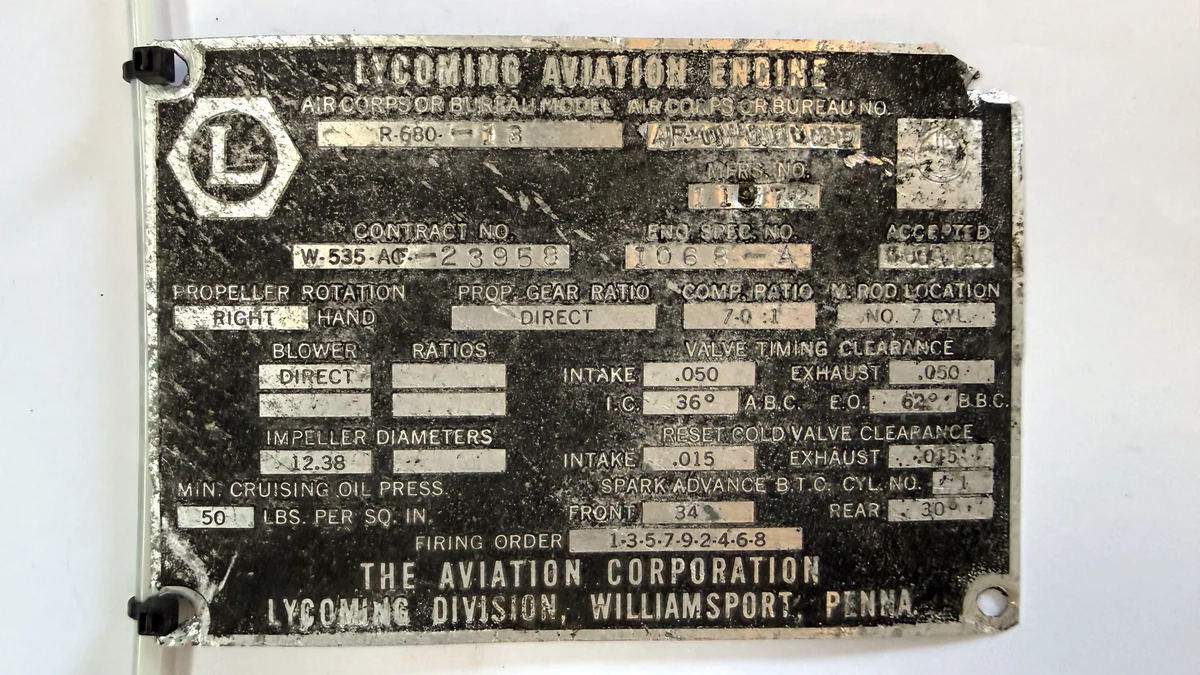
These are models with a life longer than aviation's: that same W-670 was also bought by the U.S. Army and the U.S. Navy for vehicles that did not fly. That story deserves an article of its own, not this page.
The detail that explains why they are turned by hand
Anyone who has watched a radial being started has seen someone turn the propeller by hand a few times before switching on. It is not a ritual: it is a precaution against hydraulic lock. With the engine stopped, oil drains by gravity into the lower cylinders, and oil does not compress. If the piston comes up and finds oil, something has to give, and that something is the connecting rod. The figures are striking: with fifty pounds of push on the propeller, the force inside the cylinder is nine hundred pounds at ninety degrees before top dead centre, but becomes eleven thousand pounds at only ten degrees. Three quarters of a pint of oil is enough to bend a rod.
The evidence
The plates and markings photographed on the pieces. They are what this page rests on: where there is no plate, the page says so. The serial number visible on each of them belongs to the component that was photographed: every piece carries its own, and it is written on the certificate that comes with it.
In the Journal
- Radial engine — Wikipedia
- Aircraft Engine Historical Society — Jacobs
- Aircraft Engine Historical Society — Continental radials
- Smithsonian NASM — Lycoming R-680
- Lycoming — company history
- Smithsonian NASM — Jacobs R-755
- Aircraft Systems Tech — firing order
- National WWII Museum — what became of the warplanes after the war
- FAA — Aviation Maintenance Technician Handbook, magnesium corrosion
- AVweb — hydraulic lock in radial engines