
Douglas DC-8 cowling reception desks and bar
All six Arteinmotion pieces that come from the DC-8 begin with the same component: the engine cowling. That is not a matter of taste: it is the only part of that aircraft which, taken off the wing, is still a finished object.
The pieces that come from it
6 in the catalogueThe Douglas DC-8 first flew on 30 May 1958 from Long Beach and entered service on 18 September 1959 with Delta and United on the same day. Production ended in 1972 after 556 aircraft. It is America's answer to the Boeing 707, and it belongs to the first generation of jet airliners: the one where the airframe was still designed with a slide rule, and sheet metal was worked the way furniture is worked.
Why cowlings are what survives of this aircraft
The DC-8 did not disappear when its passenger career ended. It survived for a precise technical reason, and it is that reason which today puts parts within reach.
In the early 1970s governments began introducing noise limits at airports, and the DC-8 Series 60 risked being banned outright. In 1975 Douglas and General Electric proposed a way out: re-engine them. The Super 70 programme was born, run by a company set up for the purpose, Cammacorp: the old Pratt & Whitney JT3D turbofans were replaced by CFM56 engines, the same family that powers the Boeing 737. First flight 15 August 1981, first delivery March 1982. 110 conversions in all: 53 DC-8-71, 7 DC-8-72, 50 DC-8-73.
Those 110 airframes are the last to fly. Scheduled passenger service ended in August 1993 with the final Hawaiian Airlines flights; scheduled cargo in the United States stopped on 17 May 2013. The last Western DC-8 in service was NASA's flying laboratory, retired on 15 May 2024. Very few fly today, between Africa and South America.
So the Super 70s are the most recently scrapped aircraft, and the only ones from which intact cowlings can be recovered today.
Which cowling
On the cowlings in the workshop the measurement settles the question by itself. An engine cowling has to be wider than the engine it wraps, and the powerplants fitted to the DC-8 over its life differ greatly in size: the JT3C turbojet of the early series is 99 cm in diameter, the Conway of the Series 40 107 cm, the JT4A 109 cm, the JT3D turbofan of the Series 50 and 60 135 cm.
Ours are between 185 and 205 cm. The only engine ever fitted to a DC-8 that reaches those figures is the CFM56-2, which is 183 cm wide bare. The runner-up is fifty centimetres narrower. They therefore come from a DC-8 Super 70: a Series 61, 62 or 63 re-engined after 1982.
One clarification we want to make, because it bears on the honesty of the account: the external diameter of DC-8 nacelles is not published by any source. The reasoning rests on engine diameters, not on a design document. It is a sound deduction, not a citation.
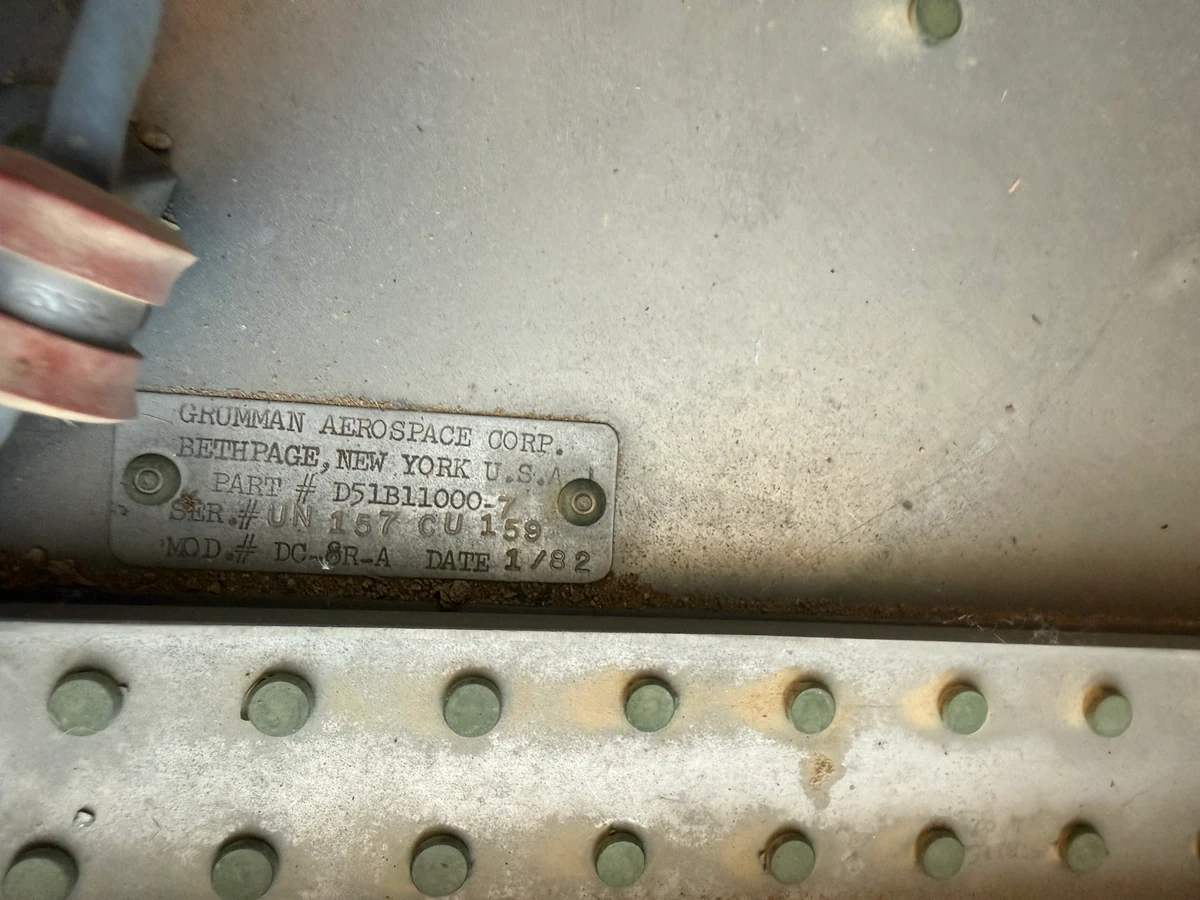
The proof arrived on 5 September 2026, and it is a data plate. Inside the
cowlings, along the edge, there is an aluminium plate reading:
GRUMMAN AEROSPACE CORP. · BETHPAGE, NEW YORK U.S.A. · PART # D51B11000-7,
MOD. # DC-8R-A, DATE 1/82. Two others read the same with different unit
numbers: units 82, 92 and 157.
What was a deduction above — the size only fits the CFM56-2, the CFM56-2 is only on the Super 70s, the Super 70 nacelles were built by Grumman — is now written on the object. DC-8R stands for re-engined: it is the designation of the re-engining programme. And January 1982 falls inside the window of that programme, which ran from 1979 to 1986.
What polishing it actually means
This part is Carlo's account, and it is the only one you will not find anywhere else. A DC-8 cowling reaches a mirror finish after nine or ten passes, and the rule governing them is brutal: get one wrong and you start again from the beginning. A crooked pass cannot be rescued by working over it.
The problem is not the aluminium: it is the titanium rivets. Titanium and aluminium do not polish the same way, and they sit a few millimetres apart. Bringing them up together takes a great deal of experience, and the titanium parts have to be polished separately, with different techniques.
Before any of that comes working out where to cut. The shape is compound and the references are few: marking out can take two days of work. Then the polishing begins, and for a piece like the bar cabinet AIR-BAR0197 (or for the counters that come from the same cowling) it runs to at least a hundred hours.
The offcuts do not go to landfill: they are recycled.
The day an airliner went through the sound barrier
On 21 August 1961 a factory-fresh DC-8-43, registration N9604Z, climbed to 52,090 feet over Edwards Air Force Base and pushed over into a dive. It reached Mach 1.012 at 41,088 feet: the first civil airliner in history to exceed the speed of sound. At the controls was William Magruder, who three years earlier had been co-pilot on the prototype's first flight.
The manoeuvre nearly ended badly. In the pull-out the elevators lost authority and the horizontal stabiliser jammed. Magruder saved himself with a counter-intuitive move: he pushed the nose further down to unload the aerodynamic force on the tail, until the stabiliser motor started turning again. The aircraft recovered at 35,000 feet. That airframe was later delivered to Canadian Pacific, renamed Empress of Montreal, and scrapped in 1981.
The DC-8 and Italy
Alitalia ordered Conways for its own Series 40 as early as 1956 and put its first jets into service in 1960. But the story worth telling is that of a single aircraft. On 14 May 1969 Alitalia took delivery of a DC-8-62H, registration I-DIWK, named after Giacomo Puccini. In 1979 it went to Braniff; then it was re-engined with CFM56s and became a Super 72; in 1986 it was bought by NASA.
As N817NA it flew as a scientific laboratory until 15 May 2024: fifty-five years of service, the last thirty-seven of them for research. It is now at Idaho State University, where future maintenance engineers learn their trade on it. It was an aircraft born Italian, and it carried the same family of engines as the cowlings on this page.
The evidence
The plates and markings photographed on the pieces. They are what this page rests on: where there is no plate, the page says so. The serial number visible on each of them belongs to the component that was photographed: every piece carries its own, and it is written on the certificate that comes with it.
- Douglas DC-8 — Wikipedia
- This Day in Aviation — the first flight, 30 May 1958
- This Day in Aviation — the supersonic flight, 21 August 1961
- Delta Flight Museum — Douglas DC-8, 1959–1989
- EASA TCDS E.066 — CFM56 engine
- MacDac West Retirees — the DC-8-70 programme
- NASA — the DC-8’s last flight
- PlaneLogger — the record for N817NA, ex I-DIWK