
The three declared levels
Provenance
What we know about every piece, and what we do not.
On Arteinmotion's product pages, the provenance of every recovered piece is declared at one of three levels. For some pieces we know which aircraft they flew on. For others we know the type but not the individual airframe. For others still we know only that they are genuine aircraft parts.

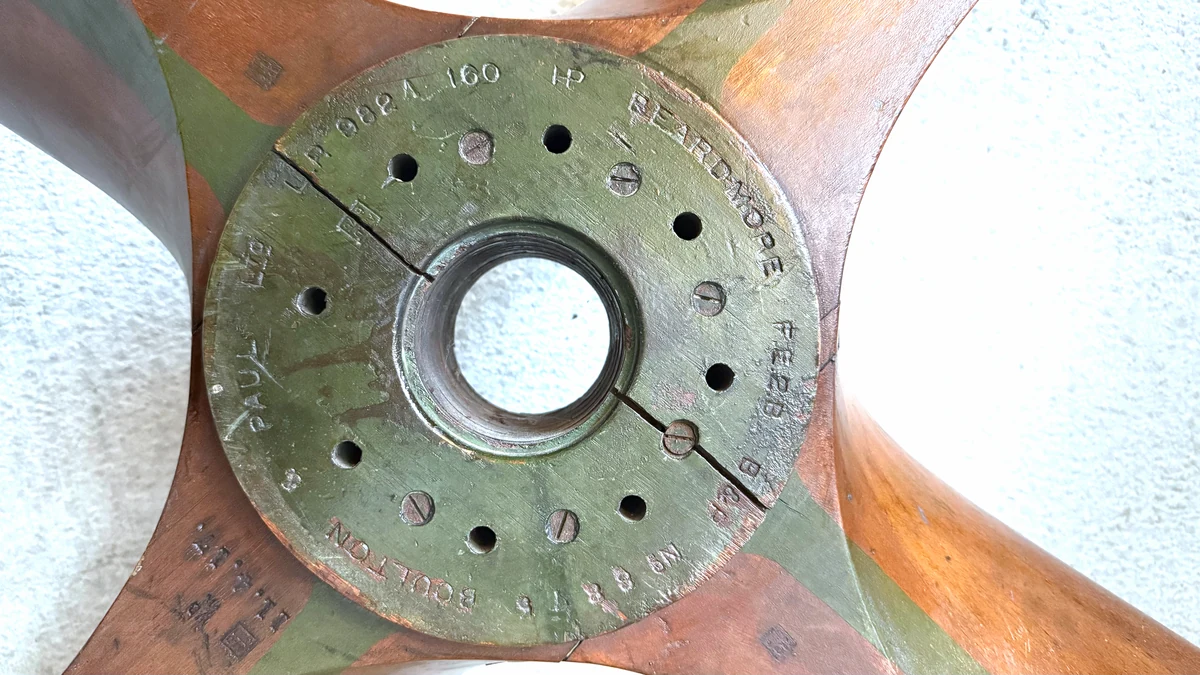
The Boulton & Paul transfer, Norwich, still on the wood
A piece of furniture made from an aircraft part is worth something for two reasons: as an object, and as a document. The first you can judge by looking at it. The second you cannot. And in this trade, that is the part people talk about a great deal and prove very little.
So we declare what we know, piece by piece, on three levels. These are not a marketing label: they are three different grades of evidence, and the third is not a flaw to be hidden.
We know which individual aircraft flew: its registration, its operator, its years in service.
Level I ↓We know which model of aircraft the component came from, but not which airframe.
Level II ↓We know the piece is a real aircraft part, and nothing more.
Level III ↓Level I — the registration is known
We know which individual aircraft flew: its registration, its operator, its years in service. A piece like that has a career you can tell: where it was built, who it flew for, when it was withdrawn.
It is the rarest level, and it is worth saying why. An aircraft's serial number is on the airframe data plate, not on the individual panels. When an aeroplane is broken up, the parts go into separate lots and the registration does not follow them. Reconstructing it afterwards is possible only if a marking survives on the part itself.
Level II — the aircraft type is known
We know which model of aircraft the component came from, but not which airframe. This is the level of most of the collection, and the one we have worked on hardest: the aircraft pages on this site exist to show how we got there.
The method is always the same, and it can be checked. You measure the part, you compare the measurement against the published diameters and dimensions of the engines and components that aircraft carried, and you see which one fits. Our DC-8 engine cowlings measure between 185 and 205 cm, and the only engine ever fitted to a DC-8 that is wide enough is the CFM56-2: they come from a Super 70. Our 737 fans measure 98 cm; the JT8D's fan measures 101, the CFM56-3's 152: they come from a 737-100 or -200. The A310 ring measures 265 cm, and the published maximum diameter of the CF6-80C2 is 269.
When the reasoning does not close, we say so. On the 747 we never got to a specific engine, and the page says so; on the Sikorsky disc no documented dimension matches, and the page says so. That is how a deduction stays a deduction instead of quietly turning, through repetition, into a fact.
Level III — genuine part, aircraft undetermined
We know the piece is a real aircraft part, and nothing more. These are the skin panels, which come from different aircraft: the fuselage sections page gathers all twelve of them. And they are the two Martin-Baker seats, which name their maker but not their aircraft.
Level III does not mean “of doubtful origin”. It means the origin exists but cannot be demonstrated, and that we prefer to say so. A curved sheet of airliner skin looks like the curved sheet of every other airliner: without a stamp, no measurement tells them apart.
When there is no level
Not every piece in the collection is a part recovered from an aircraft. Some come from their historic manufacturer, who still makes them today. Those carry no provenance level, because the three-level scale is for recovered parts: on their product page, in place of the level, you will find the name of who makes them. Others are not aircraft parts at all: Italian seating and carbon fibre furniture. On their product page, in place of the level, it says that they are Italian-made furniture, made to order. And in the two Stearman tables the wing ribs come from the assembly kits used in the United States to return Stearmans to flight, and the spars are machined to the original drawings, dated and signed: the wing does not come from an aircraft that has flown.
Two things we do not do
We never invent a registration, an operator or a service date. If the field is empty on the product record, the page does not mention it. That is a practical rule before it is an ethical one: an empty field stays empty until there is a document to put in it.
We do not use the level as a selling point. You will not find “eighty per cent of our pieces are Level I” anywhere on this site. The level is information belonging to one product page, not a number to display.
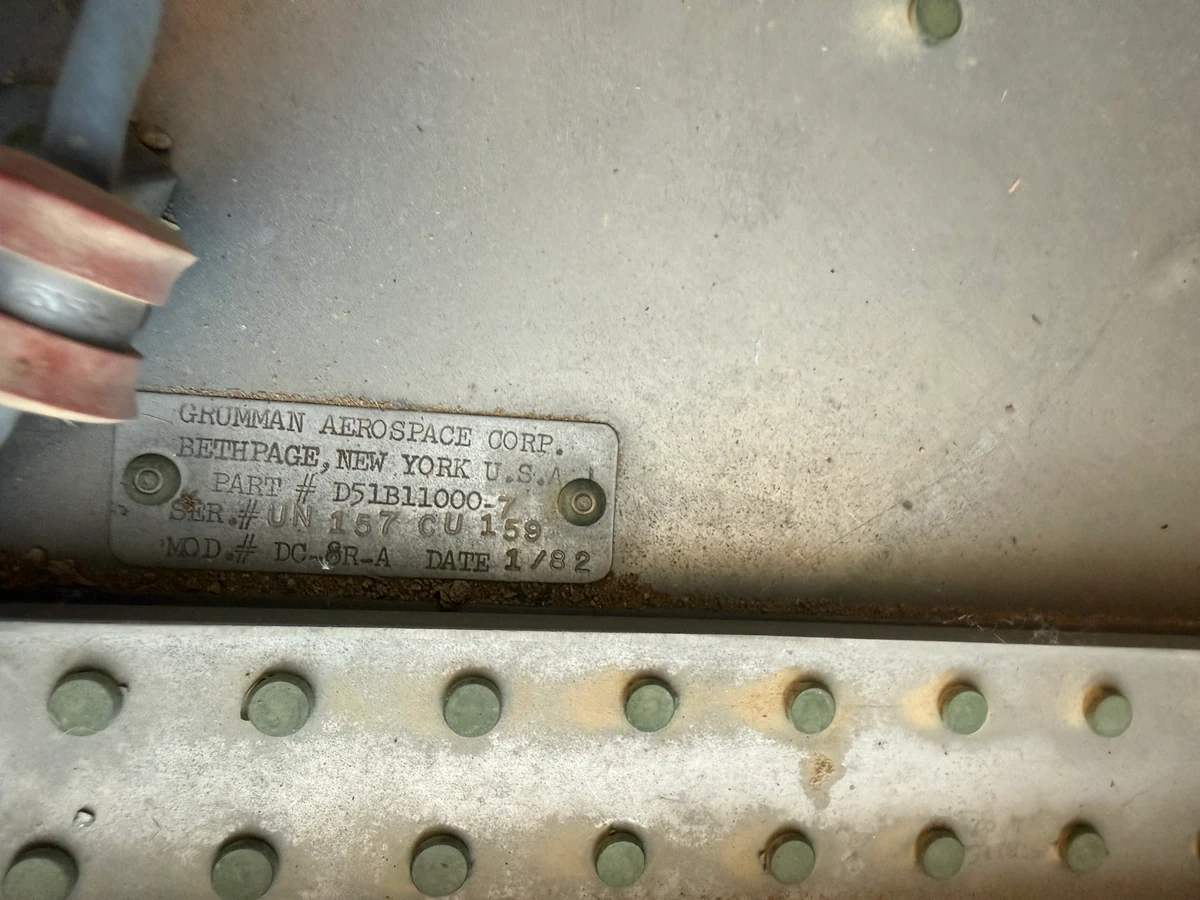
The certificate that travels with the piece
Up to here the three levels are explained in words. This is the document that goes into the crate with the piece, and it says the same things one by one, about that example.
There are four numbers on an aircraft plate, and they are not worth the same. The model says which aircraft the component was made for, the manufacturer code who made it, the part number the drawing: they are the same on every component of that type, and you will find them on the pages of this site too. The serial number identifies one single piece and changes from one example to the next (that one we never publish here). It lives on the certificate, beside the photograph of the plate it was read from.
The paragraph that matters most is the last one on the sheet, and it also states what we do not know: which aircraft that cowling was removed from is not declared, because the serial number of a nacelle is assigned by whoever built it and does not follow the registration of the aeroplane. It is the same reason that piece is Level II and not Level I.

How it can change
A piece can move up a level, and there is only one way it happens: a marking turns up. A manufacturer's plate, a part number, an inspection stamp. Some pages on this site say exactly where to look for one — on the trailing edge of a cowling, on a propeller hub, at the root of a blade.
When one of those markings appears, the product page is updated and the account becomes more precise. It is why this site is built to be corrected rather than to be finished.