
Boeing 747 engine cowling bar
A single piece comes from the 747: a bar counter with a 300 cm glass top, made from an engine cowling that measures about 270 cm on its own, the largest in the collection.
The pieces that come from it
1 in the catalogueThe Boeing 747 flew on 9 February 1969 and entered service on 22 January 1970 with Pan Am, on the New York–London route. Production closed fifty-four years later: the last aircraft left the Everett plant on 6 December 2022 and was delivered to Atlas Air on 31 January 2023. 1,574 aircraft in all.
Why it has a hump
The answer is that the 747 was not meant to last. When it was designed, at the end of the 1960s, everyone, Boeing included, took it for granted that within a few years passengers would move to supersonic aircraft: Concorde was coming and Boeing itself was designing the 2707. The 747 was therefore drawn so that it could become a freighter without being redesigned: to load containers lengthwise the nose had to lift like a bonnet, and to lift the nose the flight deck had to be above the cargo floor. Hence the hump.
The supersonic never came, the 747 stayed a passenger aircraft for fifty years, and the hump became its recognisable feature. It is one of the most famous shapes of the twentieth century, born as the solution to a problem that never arose.
Which engine this cowling came from
Here, unlike on the A310 page, we do not get there, and we say so.
Six engine families were fitted to the 747: Pratt & Whitney JT9D, General Electric CF6-45, -50 and -80C2, Rolls-Royce RB211-524, PW4000 and (only on the 747-8) the GEnx. Fan diameters range between 219 and 266 cm. Our piece is described by three overall dimensions, 270 × 135 × 102 cm, which are those of a curved panel, not of a complete ring: from three overall dimensions of a panel you cannot work back to the diameter of a fan. It would be easy to pick the closest number and call it proof. It is not proof.
What can be said with some grounding concerns the period, not the manufacturer. The 747s reaching teardown today are overwhelmingly 747-400s, retired en masse between 2017 and 2021: the early 747-100s and -200s were scrapped between the 1990s and the 2000s, and the 747-8s, few and recent, still fly almost entirely as freighters. This cowling almost certainly comes from an engine of the 747-400 period. Which of the three fitted to that series, we do not know.
The three makes of the 747, and ours
The 747 never had a single engine. Boeing offered it from the beginning with three different manufacturers (Pratt & Whitney, General Electric and Rolls-Royce), and the airline chose. It is why two 747s of the same series can have nacelles that look nothing alike.
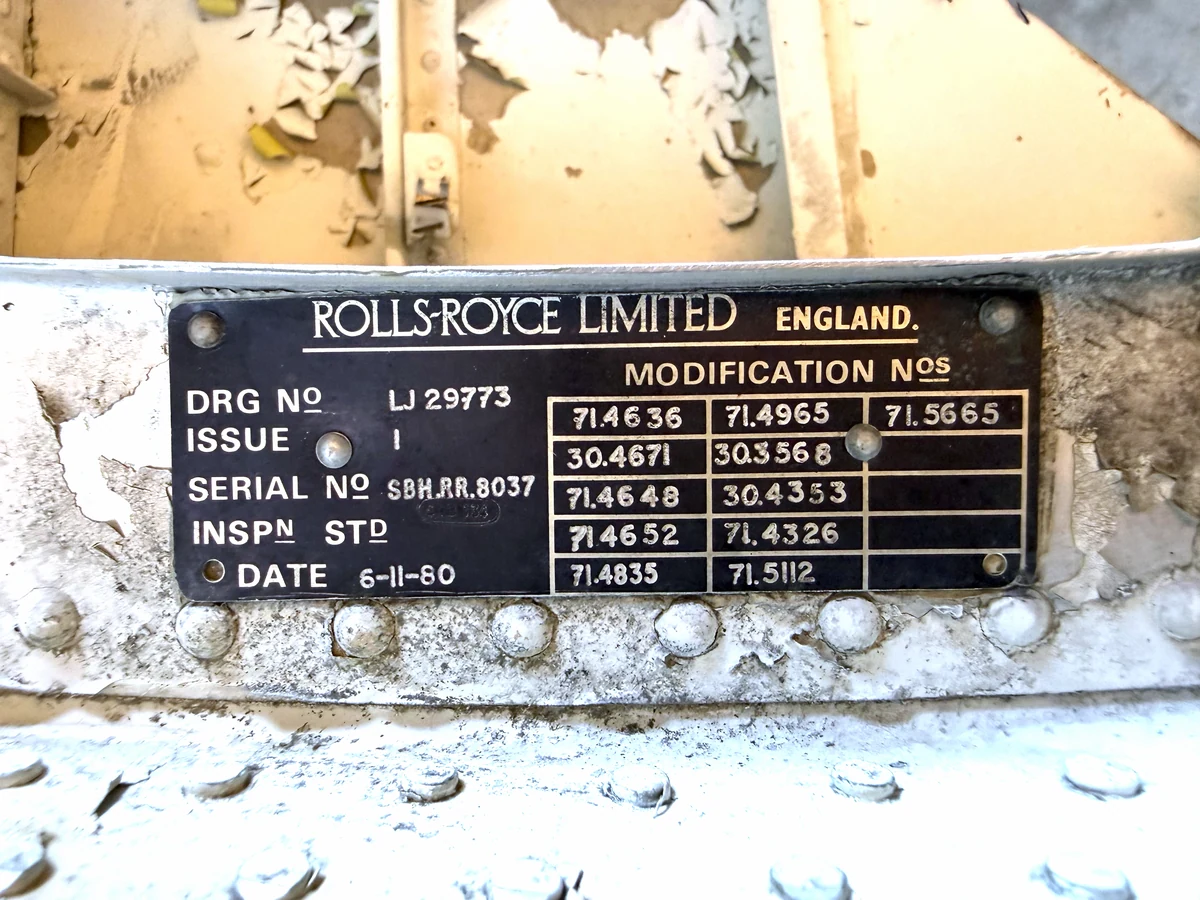
The cowlings in our store carry an aluminium plate reading ROLLS-ROYCE
LIMITED · ENGLAND, with the drawing number LJ 29773, the issue
ISSUE 1, the serial SERIAL N° SBH.RR.8037 and the date:
6 November 1980. Below are eleven embodied modification numbers.
The company name confirms the date on its own: «Rolls-Royce Limited» is the company's name between 1977 and 1986. Before that it was «Rolls-Royce (1971) Limited», afterwards «Rolls-Royce plc». In November 1980 the Rolls-Royce engine of the 747 was the RB211-524, which entered service in 1977 with British Airways.
Every piece leaves with its own document. Not a general statement about the model, but the transcription of the plate that is on that cowling: maker, drawing number, serial, date. It is the one thing nobody can write without having the piece in hand. And it is why this page exists.
Where the 747s end up
Three places, all documented. Victorville, in California, where in November 2017 United's last passenger 747 landed for the last time. Twente, in the Netherlands, where in June 2020 six Lufthansa 747-400s grounded by the pandemic arrived, and where a Dutch environmental rule prevented them for months from leaving again. And Cotswold, in England, Europe's main airliner recycling platform.
At Cotswold there is also the counter-example: the 747-400 G-CIVB, ex British Airways, was not scrapped. Since October 2020 it has stood there, whole, as an events and conference venue. Not every 747 ends up in pieces, but the ones that do give pieces as large as this.
The evidence
The plates and markings photographed on the pieces. They are what this page rests on: where there is no plate, the page says so. The serial number visible on each of them belongs to the component that was photographed: every piece carries its own, and it is written on the certificate that comes with it.
- Boeing — the official 747 programme page
- Boeing — the delivery of the last 747, 31 January 2023
- Atlas Air — taking delivery of the last 747
- Boeing 747 — Wikipedia
- General Electric CF6 — Wikipedia
- General Electric GEnx — Wikipedia
- Rolls-Royce RB211 — Wikipedia
- Southern California Logistics Airport (Victorville) — Wikipedia
- Enschede Airport Twente — Wikipedia
- Cotswold Airport — Wikipedia
- This Day in Aviation — the first 747 rolls out, 30 September 1968