
A wooden propeller with the date it was finished pressed into it: 11 April 1917
Almost everything that passes through this workshop has to be identified: you measure, you compare, you reason. One piece needed none of it. On the hub of this propeller are the maker, the drawing number, the engine and the aeroplane — and on the wood, two inspection stamps away, the day it was finished.
It is a four-bladed laminated wooden propeller, with the original transfer still stuck to one face. It was made for a British biplane of the First World War, and it is the oldest object that has passed through our hands. But the age is not the remarkable part: the remarkable part is that it introduces itself.
What is written on it
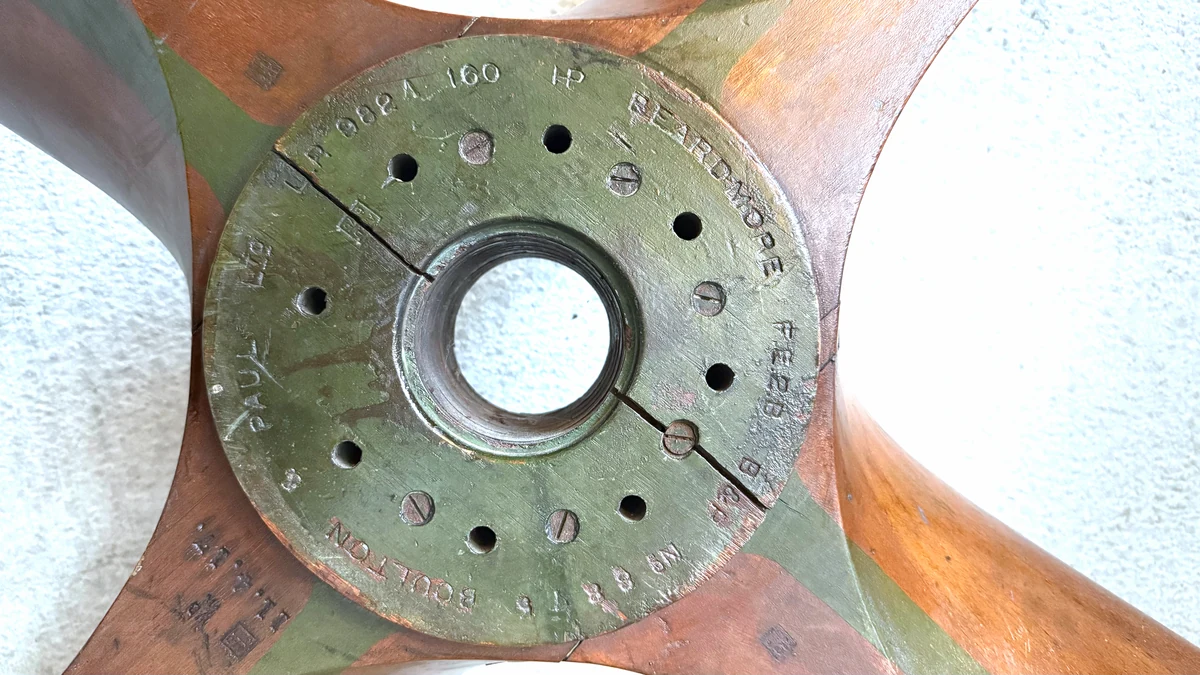
On the hub, stamped in a circle, is everything you need:
- BOULTON & PAUL Ltd — the maker, of Norwich;
- T.P. 902 A — the propeller's drawing number;
- 160 H.P. BEARDMORE — the engine it was made for;
- F.E.2B — the aeroplane, written out in full.
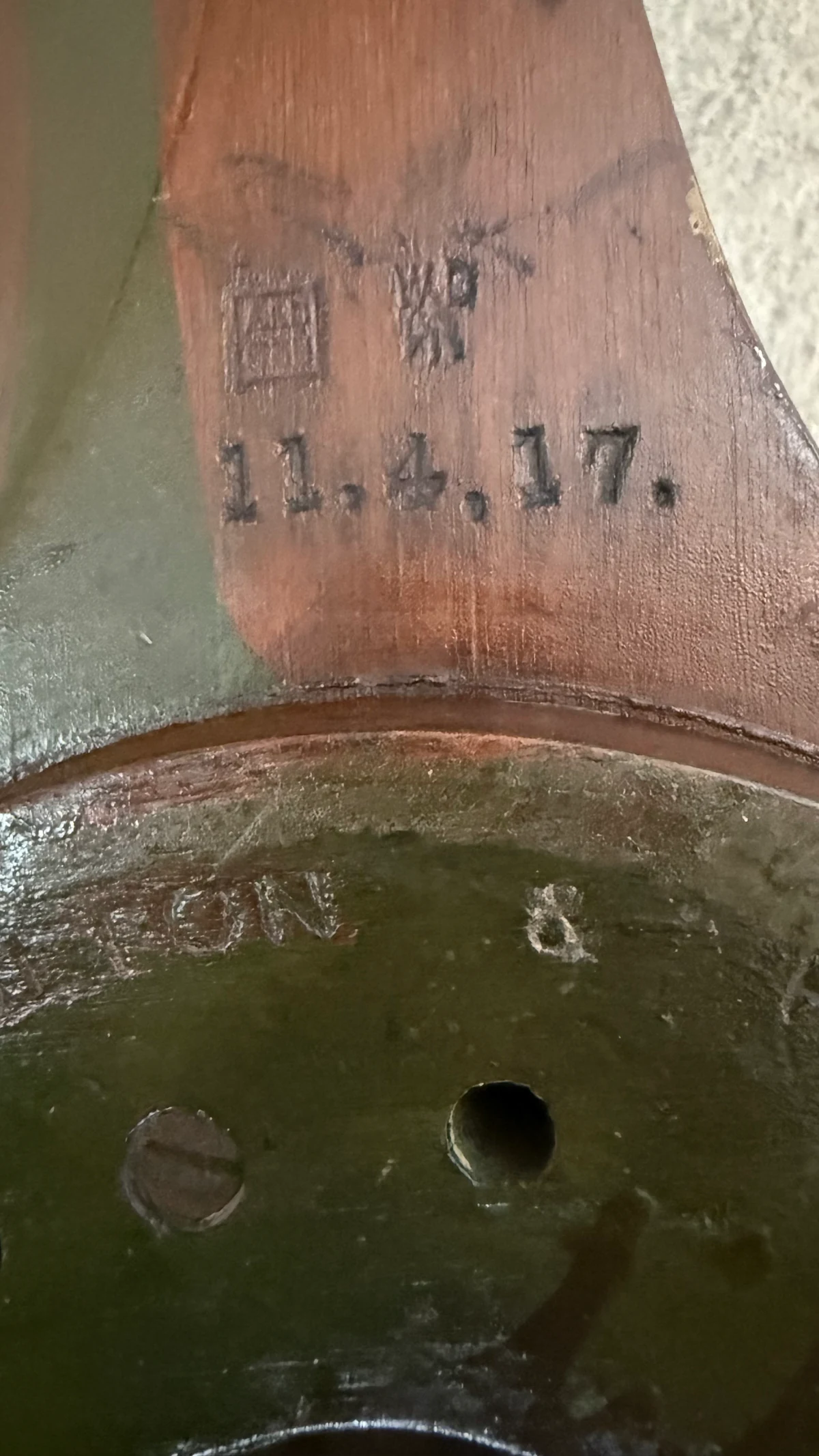
On the wood, towards the root of one blade, is the date — 11 . 4 . 17 — with two inspection stamps beside it. One of the two is the broad arrow between the letters W and D: the mark of the British War Department, the sign by which the Crown declares an object to be public property. It has been in use since the fourteenth century, and it is the same symbol found on the boundary stones of English military land. That arrow means the propeller was accepted by the War Department: it no longer belonged to the factory, it belonged to the Crown.
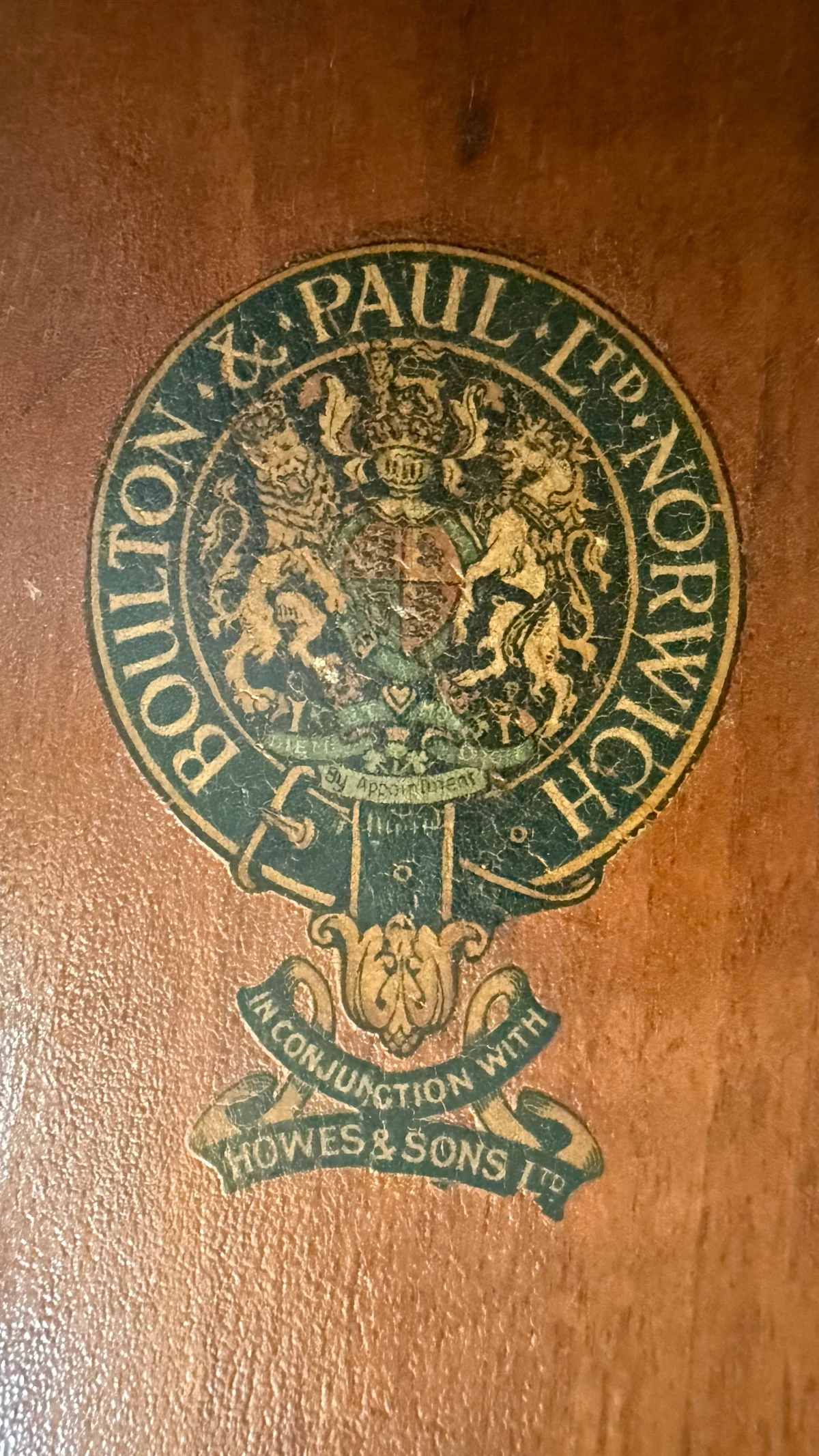
And on the flat face the transfer is still there: the royal arms, the words BOULTON & PAUL Ltd · NORWICH and, on a ribbon above, in conjunction with HOWES & SONS Ltd, another Norwich house, coachbuilders. What exactly that «in conjunction with» meant, in 1917, we do not know: we have found it written nowhere, and we are not going to invent it.
The date reads in the British order, and that is why there is no ambiguity: the maker is written on the object and is British, and in the United Kingdom the date is written day-month-year. 11 April 1917.
Why a propeller was signed in 1917
Today an aircraft component carries a part number and a serial on a metal plate. In 1917 the propeller was the plate: the maker, the engine, the drawing and the date were pressed straight into the wood, because the wood was the part.
The reason is practical. A propeller of those years is a critical structural component built by subcontractors: furniture factories, coachbuilders, joinery shops that two years earlier had been doing something else entirely. Marking the piece was the only way of knowing, a year later and a thousand kilometres away, who had made it and to what drawing. It is traceability, with the tools available: a punch and a steady hand.
Who Boulton & Paul were
This is the surprising part. Boulton & Paul began as an ironmonger's shop, in 1797. By the late nineteenth century it was among the leading makers of corrugated iron building kits, and it shipped prefabricated houses and bungalows all over the British Empire and to South America: prefabricated structures, not aeroplanes.
In 1915 it began building aircraft under contract, and proposed an aerodrome at Mousehold Heath, on the edge of Norwich, so that finished aeroplanes could fly from there: the first F.E.2b flew there in October 1915. It would build around five hundred and fifty F.E.2s, of the b and d versions. And it would build more Sopwith Camels than any other company in the world.
Within two years, a firm that sold demountable sheds had become the largest builder of the most famous fighter of the war. It is a trajectory you can read in two lines of an encyclopaedia and which, looking at this propeller, you can touch: the wood is worked by people who had known how to work wood for a century, and who found themselves doing it for aviation.
The engine, which came from the enemy's drawing
The propeller says 160 H.P. BEARDMORE. The Beardmore 160 is a water-cooled six-cylinder inline of 16.6 litres, giving 186 horsepower at 1,450 rpm and weighing 279 kilos. 2,556 were built between March 1916 and December 1918.
What is worth knowing is where it came from. The Beardmore 160 is a development of the Beardmore 120, and the Beardmore 120 is a licence-built Austro-Daimler 6. That is: the engine pushing a British aeroplane in 1917 grew out of an Austrian design, bought before the two countries found themselves on opposite sides. The licence was taken in 1913; the war came after.
There is an industrial detail too that says a great deal about those years: the engine carries the Beardmore name, but the ones actually building it were Arrol-Johnston and Crossley Motors, on behalf of William Beardmore & Company. A propeller made by a builder of sheds, for an Austrian engine assembled by two motor-car factories: in 1917 the aviation industry did not yet exist as a category. There were workshops that knew how to make things.
Why four blades
The reason is aerodynamic and simple: for the same power absorbed, a four-bladed propeller can have a smaller diameter than a two-bladed one. On a pusher aircraft like the F.E.2b, where the propeller turns behind the cockpit between the two tail booms and close to the ground, diameter is exactly the constraint you cannot widen.
This is reasoning, not a citation: we have found no manufacturer's document explaining the choice. We write it for what it is.
What was happening in those months
In the spring of 1917 the F.E.2b was changing trade. The new generation of German fighters had outclassed it, and a pusher biplane of a hundred and sixty horsepower found it ever harder to defend itself in daylight. It was not scrapped: from February the first squadrons flying it by night were formed, as a light tactical bomber, and it flew by night until August 1918.
This propeller was finished in those very months, while the aeroplane it was made for was changing trade. We do not know whether it flew, nor whether by day or by night, and without a document we will not write that we do: we know the day the wood was stamped, and for an object of this period that is already far more than is usually known.
A Beardmore found in a shed
There is one last thing, and it brings us back to the wood. When a flying replica of the F.E.2b was built in New Zealand, they found the engine. A real Beardmore, recovered from a farm shed in Uruguay. It turned again, and that replica flew.
Which is why this propeller is left as it is: it is worth what is written on it, and taking that away would take away the object and leave the propeller.
Royal Aircraft Factory F.E.2b — the piece in the collection
- Wall Propeller · Royal Aircraft Factory F.E.2bWall Pieces & Sculpture
- Royal Aircraft Factory F.E.2 — Wikipedia
- Boulton & Paul Ltd — Wikipedia
- Beardmore 160 hp — Wikipedia
- Austro-Daimler 6 — Wikipedia
- The Vintage Aviator — Beardmore Engine History
- Aircraft Engine Historical Society — Selected Early Engines: Beardmore
- Propeller (aeronautics) — Wikipedia
- Broad arrow — Wikipedia
- Grace’s Guide — Howes and Sons